
Jason (00:00)
Hi Larry, thanks for joining the Wise in Five
Larry Weber (00:02)
Hi Jason, how are you today? Good to see you.
Jason (00:04)
Good, great to see you.
Thanks. So very excited to dive into our five questions. But before we do that, I'd love if you'd share a little bit about your amazing journey with our viewers and listeners so they get a sense of just this fantastic ride that you've been on.
Larry Weber (00:23)
Well, it's been well over four decades, which is unbelievable to me. I'm mostly known in the public relations world, having founded probably the largest PR firm in the world, Weber Shandwick, and had started loads of other businesses from one of the first digital agencies, Thunderhouse, to RacePoint, which is my current company, which does B2B and technology, earned media and other digital stuff. And I've written
Seven books, three of them are bestsellers. The other four were okay. And, and I've had a great life working with a lot of innovators and technology leaders from Steve Jobs to Bill Gates to Tim Berners-Lee. And so it's been, it's been fun and it keeps going. So, you
Jason (00:54)
Hahaha
Yeah, pretty incredible. So why don't we dive in? And my first question, which I really ask everyone who joins is, where do you find inspiration just in everyday life?
Larry Weber (01:21)
Well, good question. You know, it depends on the day, I guess. But if it's a real business day, I go back to my mentors, which a lot of the audience might not know, but people like Harry Figi, who really was the pioneer and leverage buyouts and building holding companies. And I got to be his head of advertising and marketing and PR and
I learned quite a bit from him and then I moved on to ⁓ Michael Dertouzos, Professor Dertouzos, and he started the lab for computer science at MIT. And he and I would have lunch at least once a month and talk about technology's impact on humanity. And obviously, you know, he was a giant. Bill Gates had a regular call with him every Monday morning.
And, they had things come out of their lab like voice recognition, HTML, et cetera. So that was inspiring to me. All the innovators I worked with over the years, the bakers who did voice recognition, Steve Jobs, know, Tim Berners-Lee with HTML. geez.
There's so many, but, I loved watching entrepreneurs and innovators that, and would never take no for an answer. And they just kept evolving and evolving. And that was terrific. And then, and then a lot of people don't know, but I'm on the other side of inspiration is my master's degrees in 20th century British and American literature from Oxford. And I got to meet two writers that I wrote.
dissertations on. One was a British woman named Doris Lessing who eventually won the Nobel Prize in 2014, I believe, before she passed. And then the other was a Pulitzer Prize winning poet in America, who W.H. Auden discovered, Adrienne Rich. And she wrote the famous collection called Diving into the Wreck. So I get inspiration from creativity, too. And I guess one of the things that stood out
on my first company, the Weber Group, is we had a reputation not just for understanding deep technology, but for being creative about the way we approached telling their stories and building narratives. So the writing part came in sort of handy when I look at it. So those are some of the inspirations, you know.
Jason (03:36)
Pretty incredible. mean, that's why you're a true Renaissance man, Larry. I mean, you covered a broad spectrum there. So obviously to what you were just referencing, you were a pioneer really in working with technology companies to elevate their presence through PR and other forms of media, mostly owned and earned media. What patterns do you see that keep getting repeated today, both good and bad, as businesses work to amplify their message?
Larry Weber (03:40)
You
Well, one pattern that continues that is bad, I'll start with that, is every innovator thinks that they have come up with a brand new revolutionary idea. And that's usually 99 % not true. And what real innovation technology is, is building on the shoulders of giants. So you evolve from, things that have been going for a long time. Take the
AI, ⁓ evolution right now, the first paper written on an AI was 1948. you get, know, you, have to say it's not this latest invention, you know, and how it builds on itself. You have to understand that story and show how it's impacting today. And what you've added by you, I mean, the company or the entrepreneur or the innovative engineer.
what you've done to change that, to make it even more valuable, to a business. And, I think that's what is not good. So if you understand that that's good and where you go, the other thing that, that is good is that most thoughtful marketing and technology people understand that the audiences want to go deep. They want to understand.
how the technology works. Then once they do, it's like looking at the engine of a car. You trust it and then you close the hood and you move on. And we're in such a fascinating time right now. When you look at it, you probably guess that there won't be iPhones or smartphones in 10 years and it's going to be some kind of AI presence around you.
Jason (05:40)
Just drilled into
your brain.
Larry Weber (05:41)
Yeah, well, they probably won't go that far yet. It'll be, you know, they keep the exploration of glasses and of a wearable of some kind is I think going to finally get closer to perfection than it has been. So, so anyway, I, know, we were lucky because we were one of the first ones to understand earned media from a deep technology point of view and, how
⁓ influencers like Forrester and Gideon Gartner. These, these groups, you know, were really born out to, to be a third party validator of innovation. And we got that. And I think that's why within four years of founding the Weber group, was the largest technology PR firm in the world. So.
Jason (06:26)
So you just led me to my third question, Larry. So can you share an early challenge you faced as founder of the Weber Group and how you overcame it to build your business?
Larry Weber (06:39)
Yeah. The earliest challenges sort of it echoes a bit what we were just talking about was we kept hiring people that were good writers and were understanding of storytelling, but they didn't know deeply electrical or mechanical engineering. So it was a challenge to integrate more of that technology understanding because the clients
At the time, we're not trained in marketing that much. was really, they were more engineers looking to help, looking for help to sell their products. And they also had soft egos because, you know, it was, well, why do we need to spend money on marketing? Because this is just touch screen. That's just the greatest invention ever. And, know, we'd have to overcome that and say, no, you've got to build this into a narrative that has impact.
it was something we had overcome. we would hire engineers, that would help that could also write and communicate. And, ⁓ and that helped us. We built this area that I always referred to as niches within niches. And by that, I meant not just integrated circuit or semiconductor category, but video, integrated circuit.
⁓ and semiconductor or gaming or, you know, again, electrical engineering based, you know, power, low power that like ARM came up with to really beat Intel. So that was pretty much what we had to do to overcome. The other thing which I wish would come back, Jason, is we had to overcome not having enough
people that understood technology marketing. And our average retainer had gotten up by 1994. We took no client under $35,000 a month in fees. And those days are long gone, but we couldn't take, the venture capitalists would yell at me, I get these phone calls. You've got to take furniture.com Larry, you've got to. And we go.
I don't know. I don't know my dog's gonna have to work on the account. Yeah, that's true. Yeah. But you know, so that was, it was tough. You know, obviously, there was only about six or seven technology specialty firms in 1995. And then within another two years, there was like 300. So yeah, yeah, we did actually. Well,
Jason (08:37)
⁓ Well, that would be good for pets.com or maybe not furniture.com.
really created a category at that point.
Larry Weber (09:01)
PR, if there's any students of PR, you know, back up till about 1982, 83, it was all generalist. It would be like going to your general practitioner doctor and he or she would try to solve any of your problems. But, you know, it sounds silly now, like you wouldn't, you have a problem with your foot. You wouldn't go to your general doctor. You'd want to find a podiatrist. Well, that's what was happening in all the professional service categories like
law and tax and you know they were getting more specific to vertical applications and so did PR needed to do that too and technology was an obvious leap and then you saw health care quickly behind there, education, politics and government, finance and investor relations so but I can't believe that's less than 40 years ago that we started to diversify by deep verticals.
Jason (09:55)
So you mentioned a couple of legends earlier, like Bill Gates, as they were launching some of their products and businesses. know Reid Hoffman, yeah, I'm sure that was fun. Reid Hoffman and a bunch of other legendary leaders like Steve Jobs. What have you seen these great leaders do that make them successful?
Larry Weber (10:03)
Yeah, we launched the Xbox. That was fun. Yeah, well.
Jason (10:16)
Like is there something that you'd say there's a characteristic that they have or a way of operating that just keeps making them successful
Larry Weber (10:25)
Well, Steve was in a category of his own. The first time I saw him speak in 1983 to Lotus Development, one of the first early software companies, and we were going to introduce 123 for the Macintosh. For those who don't know 123, it was the predecessor to Excel, which was basically an automated spreadsheet. But Steve was like watching a
a charismatic religious figure that you would just stop and follow him anywhere. so he just had that natural ability to grab your attention and tell a story. And I would remind people if they have forgotten about Steve, just go look at his introduction to the iPhone in 2007 on YouTube and you'll see what I mean.
But then the other leaders were actually really one thing that I don't think a lot of people recognize is that a lot of great innovators actually were very good observers of human behavior. And they quietly looked at what sort of could make things better from a software point of view, from a semiconductor point of view. you know, and there were people like
Andy Grove, who was a great client, who really was one of the founders of Intel back then. And when we launched the Pentium chip in the nineties, and he would say, Larry, you know, the greatest technology disappears. And that's true. So the best leaders, that doesn't mean it's gone. That means you just don't view it as technology because I. Right. Because I'll tell young people today and they'll say, AI, AI, ⁓ AI.
Jason (11:57)
just part of who you are.
Larry Weber (12:04)
And I say, but you know what, you're not going to say AI in a couple of years because it's like sitting down at a fancy restaurant and the bread is really good. You don't say, wow, the yeast in this bread is just so good.
Jason (12:16)
Well, we don't
talk about the digital world versus the analog world anymore, right? At beginning of the Internet, that was always the discussion.
Larry Weber (12:20)
Yeah.
Well, remember, here's one old thing I'll say, you guys have to bear with me. But remember when we used to go, I used to go to my wife, I'm going to go online for a while. Well, you know, it'd be like, who would say I'm going online anymore? You just always are online. You don't even, you don't even say that, you know, so, you know, and I remember Steve Case, when we represented America online, he would just say, no, we got to tell people to be online, online, online, you know, it's like,
God, so.
Jason (12:52)
That's great. We're actually at our last question. I'm going to take a cup of wisdom because I always have a cup of wisdom with you.
You mentioned AI and AI is obviously all around us. It's I don't think I can have a conversation without someone bringing up AI. But something you reference in your latest book, A New Age of Reason, and if you don't have it, it's available on Amazon, is this theme of technology for good. And so what does that look like in practice for brands and society? And I'll have a follow up, which is what steps can leaders take?
to apply that to their business.
Larry Weber (13:22)
Well, the best thing to do is to give an example. And I have a long-term client named John Deere, who is one of the 25 largest companies in the world. And you would think, how does a tractor company, you know, use technology for good? Well, the truth is they've been an innovator and an applier of inventions and innovations for decades. And they just happened the last 10 to 15 years really understand that
They aren't technically a tractor company, even though they are, they really are in the business of helping farmers have better yields in a sustainable way for the planet. And so you start to bring this filter of using technology for a good result, which would be, how are we going to feed 2 billion more people by the year 2050? Well, they're going to have to be understanding how to sustainably.
use AI. They were one of the early acquirers of a large AI company called Blue River Technology in Silicon Valley. Five hundred million dollar early AI company. and but they they framed it in doing good and doing better. Look at health care. You know, my friend Catherine Moore, who started DaVinci Systems, she was she was very
worried about the idea that we wouldn't have enough surgeons for just basic surgery work around the world. Well, and it came up with the first robotic surgery, you know, and these arms can do things like there'd been 10 million gallbladder removals already, you know, or fix your eyesight in Nigeria, but the surgeon managing the robot is in Columbus, Ohio. So those kinds of things, and there's story after story after story.
Jason (15:03)
That's incredible.
Larry Weber (15:08)
And then to get to the second part of your question, I tell in my book, A New Age of Reason, that you actually need to change up the C-suite and have somebody that is not the CTO, have somebody that's looking at innovation across, places that might not be you, your company that's doing it. You might have to use someone else's, but to use that to give a...
a benefit to humanity by the use of the technology and the products that your company's doing. And I think it's important to do that because ultimately that's going to become the best marketing. You just pull the curtain back and tell that story, you know, so you're not even making up a story. You're actually, you know, just showing the truth of how you're you're working hard to discover innovation wherever it exists so you can get
plastic out of the ocean. mean, last Christmas, my son gave me a pair of recycled ocean plastic swim trucks. Well, hey, those kids that are making those had figured out how to get some of the plastic out of the ocean. And that's great. And they're doing just fine with that business. the swimsuit doesn't fit very well anymore.
Jason (16:20)
Has nothing to do with the plastic, I'm sure.
That's great. Well, and something, I mean, against this conversation we're having, I want to thank you because we're so fortunate to have you and Rishad Tobaccowala be speaking on September 24th to this new way of working and leadership and what to do in these tectonic changes that are happening all around us.
Larry Weber (16:23)
That's true.
I can't wait for that to happen. think it's toward the end of the month, Jason. ⁓ For those that don't know, Rishad is a very special thinker and thoughtful man who helped build Publicis, the French holding company of marketing services, and really understands where innovation is going today.
Jason (16:50)
September 24th is when we're doing it.
Larry Weber (17:05)
It's going to be an exciting conversation because work isn't going back. Work is going to continue to change. And for the better, think, as AI assistants and agentic AI and predictive AI sort of take away a lot of the dull kinds of things we do every day and let us focus in on the most important things that need to be done.
Jason (17:26)
And I can't believe the two of you have not spoken together on the same stage before. mean, two legendary Hall of Fame global leaders. That's pretty incredible.
Larry Weber (17:36)
Well, know, Rishad took the easier route with paid media. I've been in earned media, which is far more difficult.
Jason (17:45)
Sounds
like we're gonna have a good conversation So my last question and this is the bonus question we finished the Wise in Five Larry you passed with flying colors No, no surprise, right? As as folks engage with you on The Wisory and thank you for being you know an amazing advisor on The Wisory What advice would you say you're best suited to share with them when they book a session with you on The Wisory?
Larry Weber (17:48)
That's true.
thank you. Yeah.
Sure.
Well, you know, this will sound sort of funny and I want to give respect to my colleagues in the consulting business like McKinsey and Bain and BCG, etc. But I think with an hour of discussion, we can find out what business you're really in. And that's what needs to be done before you can truly do impactful storytelling, marketing, earned media.
all sorts of engagement with customers. You have to really know. Like I said with John Deere, I must have yelled at them for two years saying, you're not a tractor company. Well, they kept trying to ride me out of Moline. And I said, no, you help farmers with better yields. So you could go down the line and take every company. And I would say, give me an hour. I'll ask the right questions and we'll come up with a positioning for you. That's a powerful story.
That's what I can do in a short period.
Jason (19:05)
I love
that. And it's almost like, you know, the Malcolm Gladwell blink, right? You do something 10,000 times and you can come in pretty quickly and identify what the needs are.
Larry Weber (19:14)
You got it. know, and Malcolm's a good example, you know, I knew him early on and the tipping point was a powerful story that he would tell me or told me when I had first met him. and then the outliers was great. And so was Blink. And I haven't listened to his podcast recently, but I, that was pretty pioneering as well.
Jason (19:34)
They say it's almost as good as the Wise in Five, The Wisory Wise in Five
Larry Weber (19:37)
I think you're going to surpass Malcolm, that's for sure.
Jason (19:40)
Well, thank
you. Larry, it's always a pleasure to talk with you. Thank you for making the time. Look forward to seeing you soon on September 24th with you and Rishad at the roundtable.
Larry Weber (19:45)
I always make good time.
Can't wait for that, thank you. And The Wisory is just such a great idea. Keep it going, Jason, thanks.
Jason (19:56)
Thank
you, Larry. Thanks for being part of it.


In this episode of The Wisory Wise in Five, we sit down with Larry Weber — legendary entrepreneur, author, and PR trailblazer whose career spans four decades shaping the stories of the world’s most innovative technology leaders. Larry reflects on building Weber Shandwick into the largest PR firm in the world, launching iconic products like Xbox, and advising visionaries from Steve Jobs to Bill Gates to Tim Berners-Lee.
He shares how inspiration flows from both innovators and great literature, why the best leaders are keen observers of human behavior, and what it takes to build a business grounded in storytelling and purpose. Larry also discusses lessons from the boardroom, how brands can use technology for good, and why every company must truly understand “the business they’re in” before they can tell a powerful story.
This episode is a must-listen for leaders asking:
- What patterns in innovation and storytelling keep repeating—both good and bad?
- How can technology be harnessed for good, not just growth?
- What makes legendary leaders like Steve Jobs and Bill Gates stand out?
- How do I uncover the real business I’m in and align my strategy around it?
Transcript
Read more

In this episode of The Wisory Wise in Five, we sit down with Daina Middleton — a marketing and advertising trailblazer whose journey has spanned global leadership roles in the C-suite at Hewlett-Pa...
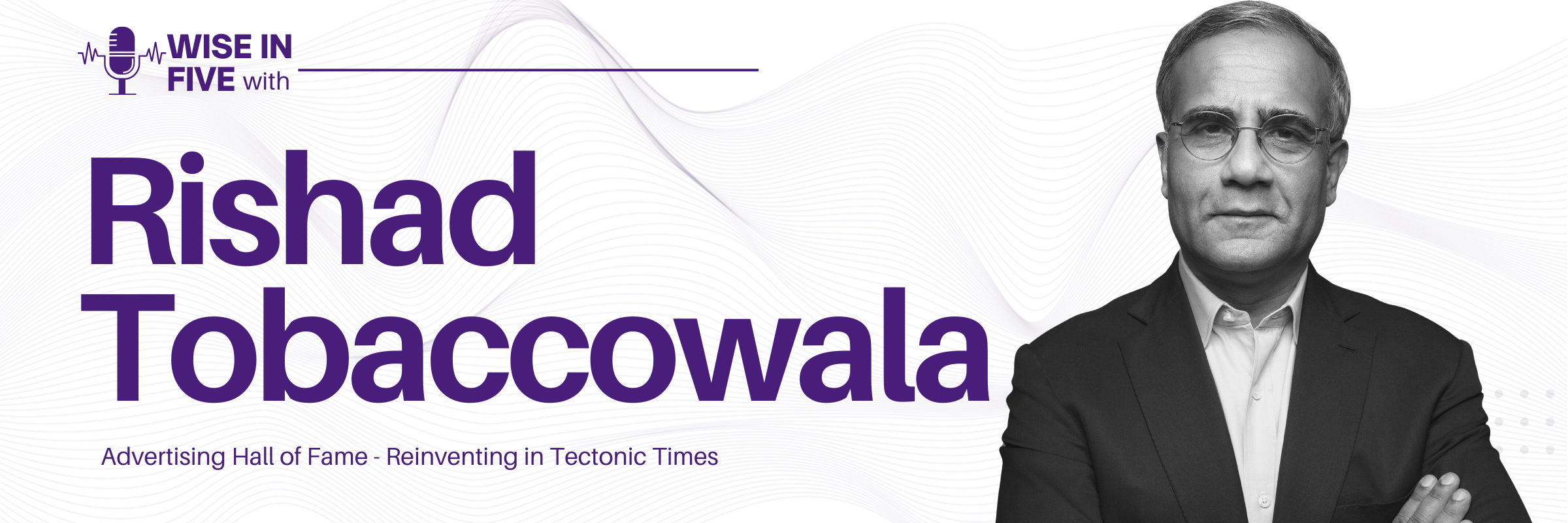
In this episode of Wise in Five with Rishad Tobaccowala — renowned strategist, author, and advisor whose career spans nearly four decades helping global companies transform. Rishad takes us inside ...